**Joseph Mazzini and Giuseppe Garibaldi were two revolutionary leaders in what would become known as Italy supporting the poor and downtrodden working class. Likewise, in France during the time of their revolution, the peasants in the Third Assembly were the ones who revolted from the Estates General and King Louis. However, in Italy there was no absolute monarch that the people were revolting against. The main difference between the revolutionaries in Italy and the revolutionaries in France was that in France their main purpose was to break away from their current monarchy, whereas in Italy their main purpose was to help the poor to a better life by first establishing a government, not by revising one that was already there.
**In France in the late 1700s, there was to be an Estates General with the nobility of the First Assembly, the clergy of the Second Assembly, and the common people of the Third Assembly. However, thinking they deserved more rights than they were being offered, the people of the Third Assembly rebelled, refusing to attend the Estates General, locking themselves inside a tennis court building, and writing their Tennis Court Oath. The people of what was now being called the National Assembly wanted a new kind of government, which was the main reason that they revolted. They wanted King Louis to overturn the throne, or at least establish some sort of unicameral or bicameral assembly so that power would be evenly distributed within the country. They wrote various documents including a new constitution to try and get their current leaders to see that something must be changed.
**Mazzini and Garibaldi and their followers revolted because of almost the exact opposite reason. In the loose confederation of city-states that would become known as Italy, there was nothing that united them like the King united France. Lombardy and Venetia were owned by Austria, Piedmont-Sardinia was its own independent state, the Vatican had its own territory in the papal states, etc. In this convoluted conglomeration of lands and people, there was no direct order. In this boot-shaped mess, the poor people often got left behind or neglected. In France, the people were neglected because the king and his nobles went off to enjoy a life of luxury in Versailles, not because there was no nobility to take care of them and their needs.
**Mazzini and Garibaldi led their revolutions not because they wanted to change the governmental structure from something they did not like, but because they wanted to have some sort of concrete governmental structure in the first place. Just like Victor Emmanuel and Count Cavour of Piedmont-Sardinia wanted Italy to be united, Mazzini and Garibaldi also wanted some sort of order. They wanted someone to represent the poor, to make their lives better. The closest thing they had was the Vatican, but the Pope and his bishops were too involved in religion to be true governmental leaders. They could not help the poor in the same way that a King or some political leader could. France revolted because they had a real leader that they wanted to overthrow; Mazzini and Garibaldi revolted for the people, so that a new leader would come and let a new world rise up like the sun.
**Though revolutions can sometimes blend together and all seem the same, the difference between the revolution of Mazzini and Garibaldi and the French Revolution was that the former occurred in the lack of the government to help the common people, whereas the latter occurred to change the current government to help the common people. France, obviously, was at least a nation when the people revolted; Italy was not even its own independent country. In the end, both France got its constitutional monarchy and Italy got its government under King Victor Immanuel, though neither worked out exactly like the revolutionaries had imagined it.
Showing posts with label Italy. Show all posts
Showing posts with label Italy. Show all posts
Friday, 18 March 2011

Saturday, 11 December 2010
Galileo Free Response Practice 2.0
During the Scientific Revolution in Europe in the 16th and 17th century, Galileo was a great scientist who made many astronomic, mathematic, and physical discoveries. He has been referred to as the "father of science," and Pope Pius XII referred to Galileo as one of the "most audacious heroes of research." However, at that time, since many of his findings disagreed with beliefs that had always been held by the Church, Galileo made himself an enemy of the Vatican and its priests and bishops. Galileo's being persecuted by the Church because of his differing astronomical ideas was the biggest setback in expanding his studies because of the power and control the Church had over Europe at that time, and people of that time would have known much more about science sooner had it not been for this roadblock, and people today also may have even known more.
Throughout his life, Galileo contradicted the findings of multiple Jesuit priests. Galileo published The Assayer in 1623, discussing, among other things, the nature of comets. The previous year, Father Orazio Grassi had written pamphlet on comets, and because Galileo's views contradicted those written in Grassi's pamphlet, a controversy between Galileo's and Grassi's ideas arose. In another work, Galileo also contradicted Father Christoph Scheinder's ideas on sunspots. Galileo proved to be a constant struggle against the Church, contradicting its priests and forcing them to turn their people against Galileo. With these priests discouraging their followers and students from Galileo's works, people were less likely to read them, fearing the wrath of God.
During the Roman Inquisition, the Vatican itself dealt with the people opposing their teachings and loyal priests. In 1616, they banned Copernicus's Orbium Coelestium, putting it on the Index of Forbidden Books. This alone was enough to discourage people from listening to Galileo, whose work was largely based on Copernican theories of heliocentricism, instead of the Church's ideas of geocentricism. This was also the year that Galileo was chastised for his findings and asked to repent by Cardinal Bellarmine. The Vatican made an example out of him to show the people what would happen to them if they went against the Church, which no one was eager to do now. This time, Galileo refused and continued on with his work. Galileo went on trial in 1633, in which the verdict was that Galileo had committed great acts of heresy, and was forced to sign a form, formally announcing that he was wrong. Further printing of his works were banned, making it very difficult for Europeans to get a hold of his now-heretic discoveries. It was not until 1718, almost one hundred years later, that the current Pope lifted the ban on his works and they were able to be printed yet again. That is one hundred years in which people could have learned the truth about the tides, the truth about the position of the earth, and the truth of many more various astronomical phenomena. If not for the Church, people of 16th and 17th century Europe would have been much more educated about the sky above them.
If not for the discouraging Church, Galileo may have even discovered more than all that he had in his time. All the time he spent fighting the Church could have been used to even further improve his compass or telescope design, for example. He could have taken more time to stargaze and report even more on what he saw. Instead, he was exhausting his efforts trying to spread his truths to the whole of Europe. In the last years of his life, when he was under house arrest for heresy, he could have been discovering even more about physics, mathematics, or astronomy. If Galileo had not been persecuted by the Church, he would have had more time to devote to his studies, and therefore would have had more to share with the world.
The Catholic Church and all of its priests and bishops were a hindrance to Galileo, even those such as Pope Urban VIII who Galileo had considered a friend. Living in Italy where the influence of the Church was greatest did not help; Galileo's whole life was spent fighting against the Church to spread his beliefs. Because the Church was so powerful, it is not a surprise that it took almost a whole century after Galileo's death for this to happen. If not for the Church in general and its representatives such as Grassi, Scheinder, and Bellarmine, the whole of Europe would have learned much more about science sooner, and people today may even know more than they currently do because of what Galileo would have been able to learn.
Monday, 6 December 2010
Free Response Practice #1
Why are the trials and tribulations of Galileo often considered both predicative of the future of Western Civilization as well as a perfect encapsulation of the context of his own time?
Galileo was a man who was born and worked during the Scientific Revolution is Europe in the 16th century. He made many advancements in astronomy, mathematics, and physics, but was also held back by the Catholic Church. Galileo's trials and tribulations throughout his life demonstrate the condition of Europe at that time because it showed how big a role the Church had -- in not only religion but also science and society in general -- and showed how close-minded Europeans could be to new things, but he looked towards the future of Europe and the world because, despite the Church and the naysayers, his findings influenced many other scientists of the Revolution and much of his discoveries are still used today.
Throughout Galileo's life and his research, his findings were not widely accepted by the European community, Jesuit priests in particular. Father Grassi had published a treatise of comets and their origins. Galileo had later published The Assayer, which contradicted Grassi's views on comets. Grassi, instead of considering the possibility that he was wrong, instead turned people against Galileo and his ideas. Father Christoph Schiender's views on astronomy also differed from Galileo's; they both had different ideas about sunspots and where they came from. Scheinder had also accused Galileo of plagiarizing from the former's book of mathematics. Like Grassi, Scheinder was not willing to accept Galileo's different ideas, and even went so far as to accuse him of stealing ideas, which may or may not have been true. These people represented the mindset of many people in Europe at that time, showing how hard it must have been for Galileo to teach others what he had learned.
In his time, Galileo also showed how powerful the Catholic Church was, and how much control it had over many things other than religion. One of the most religiously controversial things that Galileo believed in was the Copernican idea of heliocentricism. The Church had biblical reason to believe that the Earth was the center of the universe, whereas Galileo had scientific reason to believe it was not. Even when Cardinal Bellarmino gave Galileo an order to stop preaching such blasphemy, he still continued with his current works and findings. Galileo was one of the earliest people that the Vatican punished in the Roman Inquisition. An order was given to stop printing Galileo's findings, and he was put under house arrest for the last years of his life. This part of Galileo's life shows that it is not a particularly good idea to get on the Church's bad side. Though now, in 2010, the Pope seems to be exclusively the head of the Church, Galileo shows that, at that present time in Europe, the Pope and his bishops were in charge of much more than religion.
Despite the Church's bad feelings towards Galileo, he was still able to be a spearhead in the Scientific Revolution. He worked with Johannes Kepler to help develop his laws of planetary motion. Galileo had done some work on the laws of motion that had previously been established, and this work helped Sir Isaac Newton develop his laws of motion that are still accepted today. By improving the design of a compass and a Dutch telescope, Galileo was able to give others the resources to further astronomical discoveries and the study of the stars. Though he was persecuted by the Church which highly discouraged his work, he was still able to pass it on to later generations of scientists who got much use out of it. Galileo, living and working at the beginning of the Scientific Revolution, was able to be one of the men who really began the whole thing, and his work was a foreshadowing of the entire era that was about to occur in Europe. Even today, the four moons of Jupiter that he had discovered with his telescope are still widely accepted, and the Gal is a unit of measurement of acceleration named after him. Galileo's findings pointed toward much of what would be found during the future of the Scientific Revolution, and even many discoveries today.
Galileo was limited by the mindset of both the Church and the general public at the time of the Scientific Revolution, but he was still able to pass his findings on to the future of European scientists. He was persecuted up until his very last days, but he still lives on in his research. Galileo sacrificed much for his science, and showed how hard it can be to go against the Church and even Europe, but he succeeded. He succeeded in changing the world of science forever, and though there were troubles, Galileo was able to overcome them proudly, always looking to the future.
Thursday, 28 October 2010
The Prince by Niccolo Machiavelli
1.
Machiavelli, N. (1513). The prince. Retrieved from http://www.fordham.edu/halsall/basis/machiavelli-prince.html
Cesare Borgio would be a very successful businessman in today's society, especially if he were the head of an international company that used many different places to make and sell their product. In Cesare's rule, he disposed of "such forces not appearing to him reliable," (Chapter 8) until he found a group of forces which he trusted fully. With the entire world at his disposal, he would be very apt at finding the best countries and companies with which to work, and therefore very successful at turning a profit from whatever he produces.
Ramiro d'Orco, though he met an untimely public death, was as a whole successful in the task he was assigned to complete. Described as "a swift and cruel man," (Chapter 7), Ramiro would be the most successful in charge of a NGO. When Duke Valentino promoted Ramiro, "he gave the fullest power" (Chapter 7) to him. Though Ramiro was technically working for Valentino, he worked independently from him and "in a short time restored peace and unity with great success," (Chapter 7). But, eventually Valentino became afraid of the power that Ramiro held, so he executed him, impressing his subjects with "the barbarity of this spectacle," (Chapter 7)
Oliverotto da Fermo, in modern business, would be not be successful unless in a organization such as the mafia. In his rule, he used deceit and war to succeed, fighting with and murdering his own family in order to secure his position. He considered it "a paltry thing to serve under others," (Chapter 8), so he used whatever means necessary to rise above his superiors. Oliverotto put on a facade of kindness when he invited his uncle Giovanni Fogliani to visit, because "he entreated Giovanni to arrange that he should be received honorably by the Fermians, all of which would be not only to his honor but also to that of Giovanni himself who had brought him up," (Chapter 8). By acting like Giovanni's coming was going to be a splendid family reunion, Oliverotto gained his trust and was able to arrange that "soldiers issued from secret places and slaughtered Giovanni and the rest," (Chapter 8) murdering the uncle that had raised him as a son. For this clever underhandedness, Oliverotto would make a successful leader of the mafia, climbing through the ranks with his fellow assassins and committing parricide of the people thought to be his friends until he was on top, a very honorable place indeed.
2. Though a prince has many people who help him to be a successful ruler, above all, his people are a prince's greatest ally. "A prince can never secure himself against a hostile people, because of their being too many, whilst from the nobles he can secure himself, as they are few in number," (Chapter 9). If all of the people within a prince's principality disliked their ruler and decided to rebel together, they would be too much for the prince to overcome, and he would be trampled by their immeasurable force in their numbers. Also, "the prince is compelled to live always with the same people, but he can do well without the same nobles," (Chapter 9). A prince has the power to appoint whatever nobles he so chooses, so if one displeases him he can dispose of him. On the other hand, a power the prince does not have is to force the people that oppose him to leave the country. Though he could exile a few, if many choose to join forces against the prince, they will defeat him merely because of their numbers. But still considering this, "wise princes have taken every care not to drive the nobles to desperation, and to keep the people satisfied and contented," (Chapter 19) because it is always in anyone's best interest to have as many people on their side as is possible. On a military side, "it is now more necessary to all princes...to satisfy the people rather than the soldiers, because the people are more powerful," (Chapter 19). The people enjoy peace, and the soldiers enjoy the amount of money for them that comes from war, so these two groups of people are discordant with one another. Even though soldiers have war experience and many weapons at their disposal, the people still outnumber them and are the ones that must live under the prince's rule. And even with regards to this, "there never was a new prince who has disarmed his subjects," (Chapter 20). In conclusion, though many different groups of people can be beneficial to a prince, his subjects will be the most help to him in the end, but even before this one must consider that because "a prince cannot help being hated by someone, they ought, in the first place, to avoid being hated by everyone," (Chapter 19).
3. In The Prince, Machiavelli illustrates the fact that a prince must have a good balance in between being too kind and being too mean, because both could lead to his demise. He says that, "Liberality exercised in a way that does not bring you the reputation for it, injures you," (Chapter 16). A prince must at least appear kind enough to gain a reputation of being kind, but not too kind to give away everything and trust too much, for that will very likely lead to his end. Machiavelli also states that there are certain points in a prince's rule in which he should exercise generosity, and points in which he should not. With regards to different princes in different positions, he says, "Either you are a prince in fact, or in a way to become one. In the first case, liberality is dangerous, in the second it is very necessary to be considered liberal," (Chapter 16). When a man is striving to become a prince, he must show the people care and compassion in order to gain their trust and support, but once in control, he must rule with an iron fist, because "we have not seen great things done in our time except by those who have been considered mean; the rest have failed," (Chapter 16). Though generosity is an important tool for a prince of a principality, Machiavelli has the general opinion that "it is much safer to be feared than loved," (Chapter 17) for a prince.
4. Though Machiavelli does say that a prince should have good qualities, there are also many things he says which are not in line with the Beatitudes and can be considered generally immoral. One thing that Machiavelli says is that "on learning that nay one, on any consideration, has not told him the truth, he should let his anger be felt," (Chapter 23), but the Beatitudes instruct that one must be patient and kind, and even if someone did lie to said prince, the right thing to do would be to forgive them and not become enraged. Machiavelli also says, with regards to being angry, that a prince should have "injuries which it is necessary for him to inflict, and to do them all at one stroke so as to not have to repeat them daily," (Chapter 8), but a prince should be able to be peaceful and not warlike so that he has no need to injure his people. Whether or not a prince chooses to injure his people or not, Machiavelli believes that "their government is weaker and more insecure, because it rests entirely on the goodwill of those citizens," but in reality these governments will be the strongest in faith. "Blessed are the pure in heart, for they will see God," (The Beatitudes) and be able to thrive more so than those who do not have goodwill. Machiavelli is also wrong because he believes that "a man who wishes to act entirely up to his professions of virtue soon meets with what destroys him among so much that is evil," (Chapter 15) but ultimately those who are virtuous will be the ones who win in the end, "because great is [their] reward in heaven," (The Beatitudes). Even though Machiavelli believed that "some [princes] lived nobly and showed great qualities of soul, nevertheless they have lost their empire or have been killed by subjects who have conspired against them," (Chapter 19), he is wrong; these are the people that will always win in God's eyes. But, no matter how a prince "may appear to him who sees and hears him altogether merciful, faithful, humane, upright, and religious," (Chapter 18), in the end, God can always see your heart, and He is the one who decides whether said prince will enter the kingdom of heaven or not.
5. The Beatitudes create an idealistic world in which only good is done, but the world that Machiavelli writes about is a more realistic one, in which not everyone can be a peacemaker and be virtuous. He states that "a blunder ought never be perpetrated to avoid war, because it is not to be avoided, but it is only deferred to your advantage," (Chapter 3). Though "blessed are the peacemakers," (The Beatitudes), Machiavelli knows that the world is a discordant one in which people need some way to resolve their differences, so they turn to war. He even goes further into this saying that "a prince ought to have no other aim or thought, nor select anything else for his study, than war and its rules and discipline," (Chapter 14). Even though peace would be ideal, the best way to be successful is to indeed have war and be as educated as one can be about it in order to save your people. Also opposed to the Beatitudes, Machiavelli says that "not to lose again what they had acquired, they were compelled, in order to secure themselves, to murder him," (Chapter 12). Though killing people is not pure in spirit, it is sometimes necessary to ensure that more good will come from a person dead than alive. With regards to the second part of the Beatitudes, Machiavelli says that "benefits ought to be given little by little so that the flavour or them may last longer," (Chapter 8). In the Beatitudes, the rewards for people's virtue are big and immediate, but these people should be rewarded gradually so that it means more to them. Machiavelli's general belief is that "it will be found that something which looks like virtue, if followed, would be his ruin; whilst something else, which looks like vice, yet followed brings him security and prosperity," (Chapter 15). The Beatitudes are very straightforward, but Machiavelli believes that they are often wrong, and that good things will more often come from bad rather than good, unlike what the Beatitudes say. In so many words, "good works will do you harm," (Chapter 19).
Machiavelli, N. (1513). The prince. Retrieved from http://www.fordham.edu/halsall/basis/machiavelli-prince.html
Tuesday, 19 October 2010
Perugia's History and Accomadations
- History
- Much of Perugia's current art and architecture is an echo of the cultural result of periods of peace and prosperity in their past (http://www.letsgo.com/340-umbria-travel-guides-perugia-d)
- Passes are available to tour a number of museums and sights, including -->
- Accommodation
- The Hotel Priori has large rooms with private terraces, with a gorgeous view of a historical street. http://www.hotelpriori.it/index.htm
- The Albergo Anna has 17th century style rooms with a rustic charm, with ceramic fireplaces and beautiful views over the rooftops. http://www.albergoanna.it/anna.html
- The Etruscan Chocohotel is entirely dedicated to chocolate -- because of the famous chocolate factory in Perugia -- including a chocostore and a chocomenu with food. Perfect for chocoholics.
- The Brufani Palace Hotel is rated 5 stars and includes beautifully decorate bedrooms and suites, a garden terrace, helpful, friendly staff members that are able to speak at least 3 languages, and an exquisite pool relaxation area.
- Info from: http://hotels.lonelyplanet.com/italy/perugia-r1975521/, http://www.letsgo.com/17807-umbria-travel-guides-perugia-accommodations-c
- Pictures from: http://www.planetware.com/i/photo/cathedral-of-san-lorenzo-genoa-i180.jpg; http://www.hotelpriori.it/Inglese/priori'spictures.htm; http://www.hotels.com/hotels/1000000/30000/27300/27255/27255_70_b.jpg; http://farm3.static.flickr.com/2192/2277243924_2c8a045f2b_m.jpg


 |
| Cassero di Porta Sant'Angelo Offers a historical background on the building |
 |
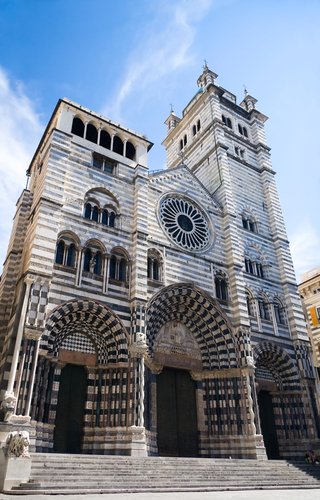
| Cathedral of San Lorenzo Gorgeous example of Gothic architecture that took 400 years to complete |
 |
| Brufani Palace Hotel Pool Area |
 |
| View of the Hotel Priori from their website. |
Subscribe to:
Posts (Atom)